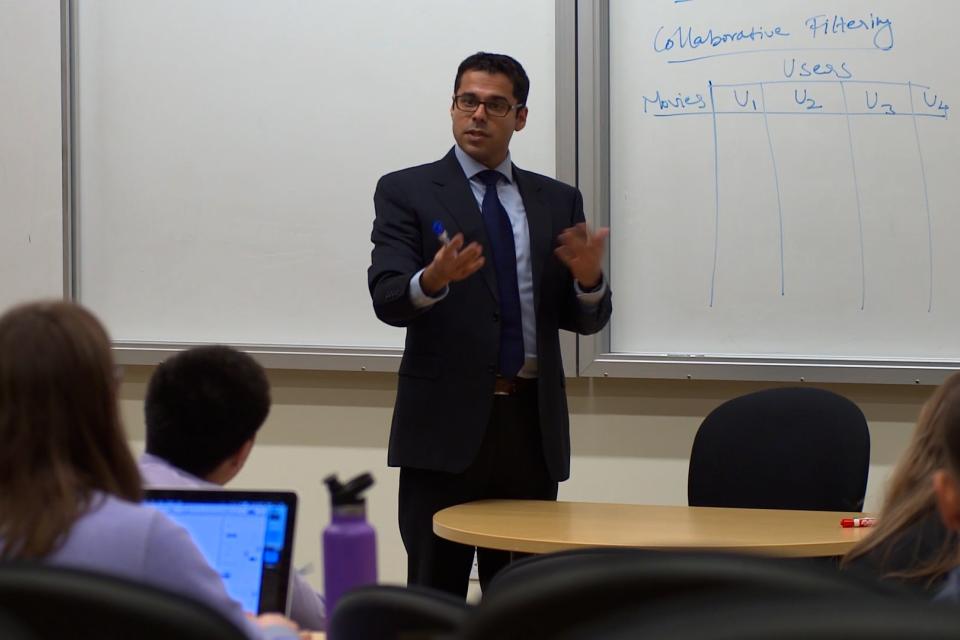
Ashwin Aravindakshan
Assistant Professor of Management
Research Expertise: Industrial organization, pricing and promotion strategies, competitive strategy, customer relationship management, marketing channels
An experienced marketing researcher and instructor, Ashwin Aravindakshan’s research interests center on industrial organization, pricing and promotion strategies, competitive strategy, customer relationship management and marketing channels.
His research on “The Effects of New Franchisor Partnering Strategies on Franchise System Size” was published in Management Science, and a second study, “Customer Equity: Making Marketing Strategy Financially Accountable,” was published in the Journal of Systems Science and Systems Engineering. His working papers include an examination of continuous relationship states as they apply to customer relations management, pricing related products in a competitive environment, and pricing software services. Aravindakshan has presented his research several times at INFORMS Marketing Science conferences.
Aravindakshan received his Ph.D. in marketing from the Robert H. Smith School of Business at the University of Maryland in 2007, where he also taught undergraduate courses on marketing principles and organization and marketing research methods. He consulted for EduMetry, an education sector assessment-services provider, on a project that involved market determination, assessment and targeting.
Room 3312

243 Customer Relationship Management
Customer Relationship Management (CRM) is a management approach under which marketing activities are organized and measured around customers instead of brands. This approach benefits firms as customers and not brands make buying decisions.
Optimizing Ad Spend to Maximize Profits
Journal of Marketing Research, 2012
What is the optimal advertising budget and allocation that maximizes profits across multiple regions and over time? The chief marketing officer of a Fortune 500 company raised the question after she noticed that increasing her company’s advertising expenditures enhanced sales as expected, while profits diminished.
Solving Share Equations in Logit Models Using the LambertW Function
Review of Marketing Science, 2011
Though individual demand and supply equations can readily be expressed in logit models, closed-form solutions for equilibrium shares and prices are intractable due to the presence of products of polynomial and exponential terms. This hinders the employment of logit models in theoretical studies, and also makes it difficult to develop reduced-form expressions for share and price as a function of exogenous variables for use in empirical studies.
How Does Awareness Evolve when Advertising Stops? The Role of Memory
Marketing Letters, 2011
Current models posit that awareness of advertising declines immediately and gradually once it is over, although anecdotal evidence from managers suggests that awareness stays constant for a while and then decays rapidly. This pattern arises because consumers remember advertisements for a finite time before they forget.
Ashwin Aravindakshan Awards
Starbucks Logo to Change
Marketing Professor Ashwin Aravindakshan says Starbucks’ new logo may help the coffee giant expand into new, emerging markets, and that existing customers who may not like the new look won’t change the habits if they like the java.
The Effects of New Franchisor Partnering Strategies on Franchise System Size
Management Science, 2006
Many young firms use strategic actions to attract partners who help them increase the size of their operations quickly. This article examines the use of strategic actions to attract partners and increase system size in the context of franchising.
Customer Equity: Making Marketing Strategy Financially Accountable
Journal of Systems Science and Systems Engineering, 2004
Traditionally, Return on Investment (ROI) models have been used to evaluate the financial expenditures required by the strategies as well as the financial returns gained by them. However in addition to requiring lengthy longitudinal data, these models also have the disadvantage of not evaluating the effect of the strategies on a firm’s customer equity. The dominance of customer-centered thinking over product-centered thinking calls for a shift from product-based strategies to customer-based strategies.