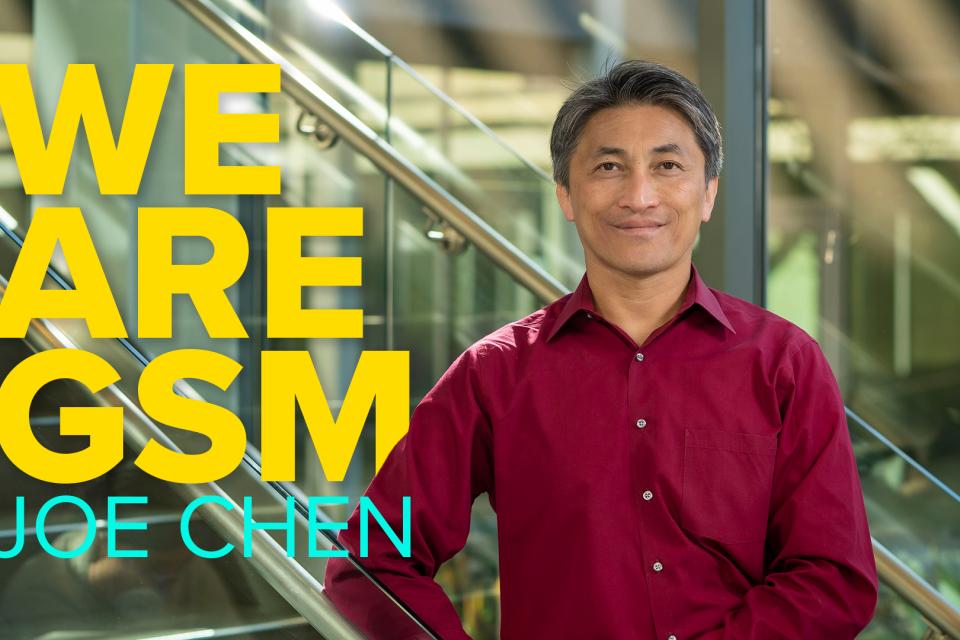
Joseph Chen
Associate Professor and Associate Dean of Programs and Curriculum

Ph.D., Stanford University
Research Expertise: Empirical asset pricing, mutual funds, and foreign exchange
Even in these roller coaster financial times, Associate Professor Joseph Chen believes it is possible to make sense of Wall Street. Chen’s research reveals that stock market returns behave asymmetrically: they are more likely to make extreme moves on the downside than on the upside, and when markets go down, different stocks are more likely to move down together than when markets move up. Chen states that this lopsidedness implies that portfolio diversification provides the least amount of protection precisely when it is most needed, because there are fewer places to hide when markets collapse.
However, Chen’s work also shows that investors are rewarded over time for taking these market risks. In fact, much of the stock market’s reward-to-risk tradeoff comes from exposures to downside risk rather than to upside potential. Chen also looks at how exposure to market risk varies over time, and investigates when extreme moves, such as stock market crashes, are more likely.
In another line of research, Chen is exploring the effects of company organizational structures in the portfolio management industry. He documents that mutual fund families exhibit increasing returns to scale, and that larger families outperform smaller ones because they can spread their fixed expenses over a wider asset base. However, Chen has also found that mutual funds themselves exhibit decreasing returns to scale, and smaller funds can better concentrate their portfolios into their best stock picks, and thus outperform larger funds. This effect is strongest for mutual funds investing in small illiquid stocks: mutual funds whose day-to-day management is outsourced to an external adviser tend to underperform internally managed funds.
More recently, Chen has turned his attention to studying the predictability in the foreign exchange market. The “carry trade” strategy involves investing in assets that provide higher interest rate yields and has long been known to be profitable, but its underlying cause is puzzling. Chen digs even deeper into this puzzle by examining how foreign exchange returns are also linked to other interest rate factors, such as the long-term bond yield and the inflation rate. He also examines how the relationship has changed across different currency exchange regimes by collecting data that spans more than two centuries across various economic environments and jointly investigating the relationship between the yield curve and foreign exchange returns.
At UC Davis, Chen primarily teaches the elective finance course on Investment Analysis, which not only prepares students to manage investment portfolios for themselves but also trains students to manage investment portfolios of others as a delegated wealth manager. He has also taught Derivative Securities, the core Finance course, and the core Statistics course. Chen also leads students on the annual International Study Trip, where MBA Students are trained in global perspectives by traveling to a different country each year.
From 2020 to 2023, Chen led the GSM as the MBA Program’s Academic Director, overseeing the curriculum across all four MBA programs at the GSM. He successfully navigated the rapid temporary transition to remote instructions during the COVID-19 global pandemic while simultaneously managing the growth of the University of California’s first Online MBA since its launch. Chen also serves UC Davis on the Graduate Council Program Review Committee, which assesses graduate education programs of other departments on campus. He also represents the Davis campus on the system-wide Assembly of the Academic Senate. Chen also co-authored and sponsored the proposal for a new undergraduate business degree program, which was approved by UC Davis for new student admission as early as Fall 2025.
Chen now servers as associate dean of programs and curriculum, planning a complex matrix of course offerings and schedules.
Chen completed his Ph.D. at Stanford University and is a Chartered Financial Analyst. He earned a master’s in statistics at Stanford and a master’s in economics and mathematics at Yale University. In the mid-1990s he worked on Wall Street as a proprietary arbitrage trader of international equity derivatives at Bear Stearns. Before joining the Graduate School of Management, Chen was on the faculty at the University of Southern California and was a visiting assistant professor at the Massachusetts Institute of Technology.
Awards
- 1st Place, Fama-DFA Prize for Best Paper in Capital Markets and Asset Pricing, Journal of Financial Economics, 2002.
- 2nd Place, Fama-DFA Prize for Best Paper in Capital Markets and Asset Pricing, Journal of Financial Economics, 2001.
- Research Grant, Q-Group, “Downside Risk and the Momentum Effect,” 2001.
- Scholarship from the Russell Sage Foundation to attend the Conference on Behavioral Economics, 2000.
- Robert K. Jaedicke Fellowship for outstanding scholarship, Stanford Graduate School of Business, 1997.