After 1,000 Job Applications, One Connection Changed Everything
How the UC Davis MSBA helped me pivot from teaching middle school to becoming a data analyst at Chime
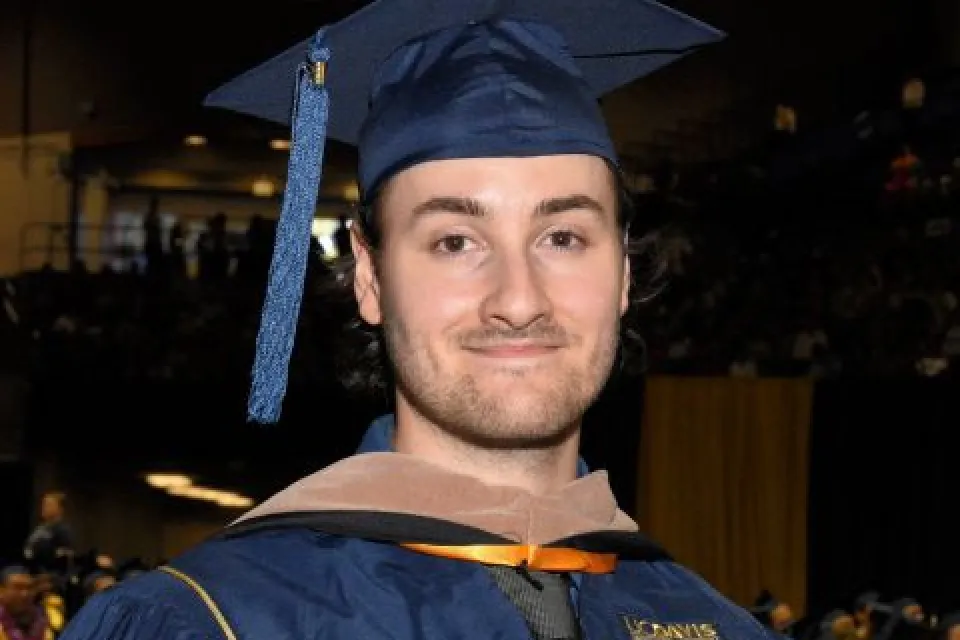
By Spencer Holsinger with Espy Foft
I've applied to more than 1,000 jobs.
I started applying in 2023, hoping my computer science degree would help me break into a technical career. But application after application went nowhere. I wasn't landing software engineering roles. I wasn't getting traction in data science. I wasn't getting offers in analytics.
Then something changed.
As I neared the end of the MSBA program, I started landing interviews for data science and analytics roles. Eventually, one of those opportunities led to a full-time position as a data analyst on Chime’s Financial Crimes and Identity team.
There was one major difference between those years of applications and the opportunity I was suddenly getting: I had enrolled in the UC Davis Master of Science in Business Analytics program.
Quite literally, the job offer I’ve received in the data field was a direct result of earning my MSBA.
Choosing a New Direction
Before UC Davis, I taught coding and math at a middle school in the Bay Area.
Teaching was fulfilling, but I knew I wasn't fully using the computer science degree I had earned at San Francisco State University. I wanted to challenge myself technically and continue developing professionally.
There was also a deadline approaching.
In California, I could teach for two years without earning a teaching credential. As those two years came to an end, I had a choice: pursue a credential and continue teaching or use graduate school to move in a different direction.
If I was going to pursue a master's degree, I wanted it to move me closer to the technical career I had imagined as an undergraduate.
I considered data science and accounting and applied to graduate programs at UC Berkeley, San Jose State University and San Francisco State University. My girlfriend, a UC Davis graduate, eventually found the UC Davis MSBA program in San Francisco.
The location immediately made sense. I already lived in San Francisco, and I could attend class without a long commute. I also saw UC Davis as offering the combination of reputation, cost and technical training I was looking for.
Learning to Think Like an Analyst
My computer science background gave me experience with programming, but I wanted more exposure to databases, SQL, Python, R and the process of manipulating and analyzing data. The MSBA put me into that work almost immediately.
I didn't have a traditional statistics background, so the early courses pushed me. Working with professors such as Continuing Lecturer Mehul Rangwala introduced me to statistical concepts at a level I hadn't experienced during my undergraduate studies.
Rangwala's enthusiasm also changed the way I thought about the subject.
He may be the most passionate person I've ever seen about statistics. I'm still not the biggest statistics person, but his enthusiasm and willingness to work with students gave me a new appreciation for it.
Professor Jörn Boehnke brought another perspective. His knowledge of machine learning and emerging technology often led our classroom discussions into what was happening in the industry in real time. Those conversations helped connect what we were learning to the work we were preparing to enter.
Pretty early in the program, I started seeing myself differently.
I wasn't someone trying to get into analytics anymore. I was doing the work of an analyst.
Solving an AI Search Problem Without a Playbook
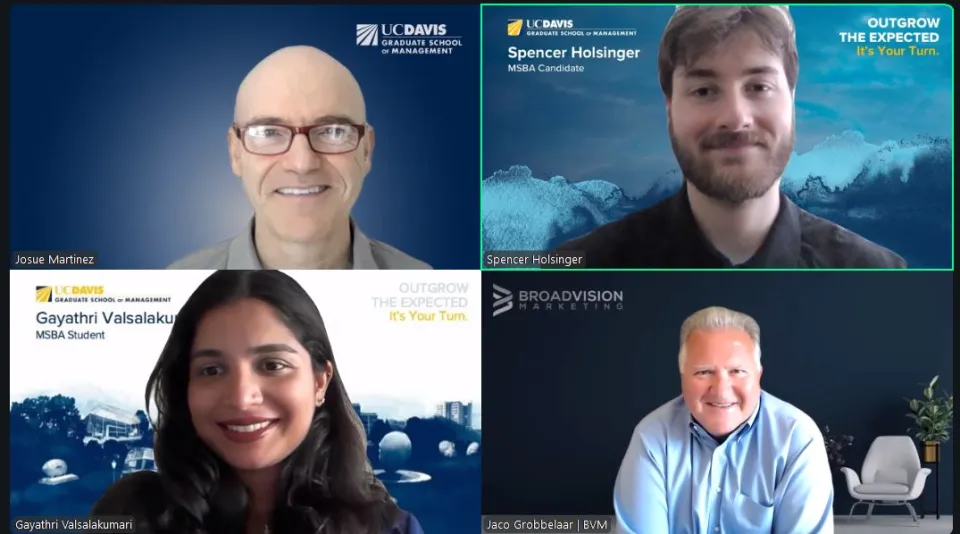
That became even clearer during my practicum project with BroadVision Marketing.
Our challenge was to understand how law firms could improve their visibility across traditional, local and AI search.
The AI portion was especially difficult because the technology is still evolving. There wasn't a clear formula we could follow to determine why one company appeared in an AI-generated response and another didn't.
So we started experimenting.
My practicum partner, Gayathri Valsalakumari, was a great teammate throughout the project. Together, we developed a web scraper, worked with back-end SQL databases and collected AI search results. We repeatedly tested prompts, tracked the sources AI platforms cited and looked for patterns in what appeared and what didn't.
We had a client who understood the business problem but didn't necessarily know what the data solution should look like. That put us in a consulting role where we had to help determine the direction ourselves.
Some approaches worked. Others went nowhere.
That trial and error became one of the most useful parts of the experience.
I learned how to work through an ambiguous business problem when nobody could hand me the correct answer.
The UC Davis Connections That Led to Chime
My career breakthrough eventually came through the UC Davis community.
Shachi Govil, director of career development for the MSBA program, learned about an opportunity at fintech company Chime and believed I could be a strong fit. She told me about the role, shared my resume with a recommendation and connected me with UC Davis alumnus and Chime employee Pranjal Srivastava.
Govil continued checking in throughout the process, while Srivastava helped me better understand the company and prepare for what to expect during multiple rounds of interviews. Their support helped me reach the final technical interview, but I still had to demonstrate that I could do the work.
I fully believe I would not have this job without both of them. Their support showed me what a strong career development team and alumni network can make possible when paired with the skills to compete for the role.
After a year at Chime, I can see how directly the MSBA prepared me for the work. On the Financial Crimes and Identity team, I run SQL queries in Snowflake to explore data and identify appropriate cohorts for A/B testing and remediation. I build dashboards in Looker and Hex to share findings with bank partners and help inform responses to audits. I also create agentic workflow automations that routinely monitor watchlists for bad actors who could compromise the platform.
The tools vary, but the core work—querying and validating data, building dashboards, automating processes and communicating findings to stakeholders—reflects concepts I practiced throughout the program.
Even the communication training I sometimes questioned while I was a student makes more sense now.
We learned to lead with the most important information, communicate efficiently and structure presentations around what an audience actually needs to know. Those skills matter when data has to inform a business decision.
Changing My Mind About AI
I entered the MSBA very anti-AI.
Then we started learning about neural networks, language models and how machines actually learn.
Understanding what was happening behind the scenes pulled back the curtain. AI became less mysterious once I understood the mechanics behind it, including its limitations.
That knowledge has made me much more comfortable using AI as a tool while still questioning its output. I still lean anti-AI, but now my skepticism is informed by a much deeper understanding of what the technology can and cannot do.
What I Would Tell Someone Considering an MSBA

I want to be realistic with anyone considering a career pivot into analytics.
It's tough.
The job market is competitive, especially in San Francisco. You're competing with candidates locally, nationally and globally. Earning an MSBA doesn't remove that competition.
You have to be willing to commit to developing yourself professionally.
For me, that meant going beyond coursework. I joined the Directors' Student Advisory Committee, served as a graduate student analyst and pursued opportunities I probably wouldn't have considered as an undergraduate, built relationships and dug deeply into the areas of analytics that interested me.
You get out what you put in. It's possible to move through a graduate program focused primarily on completing assignments and earning the credential. I think the greater value comes from finding one or two areas that genuinely interest you and understanding them deeply.
Do that, and you'll leave as a stronger data professional than when you entered.
I know because I spent years sending applications into the world and waiting for someone to give me a chance. More than 1,000 applications taught me how difficult changing careers can be.
UC Davis gave me the skills, experiences and connections that finally helped me make the change.
Related content

From Med School Prep to Machine Learning at Google
How one Python class changed my whole plan and led me to the UC Davis MSBA

What Does an AI Engineer Do?
MSBA alumnus Kshitiz Parashar shares insights on compelling, impactful AI career path
