Turning IRS Data Into Real Decisions for Nonprofits
How a UC Davis MSBA team uncovered financial risk and took first place at Aggie Hacks 2026
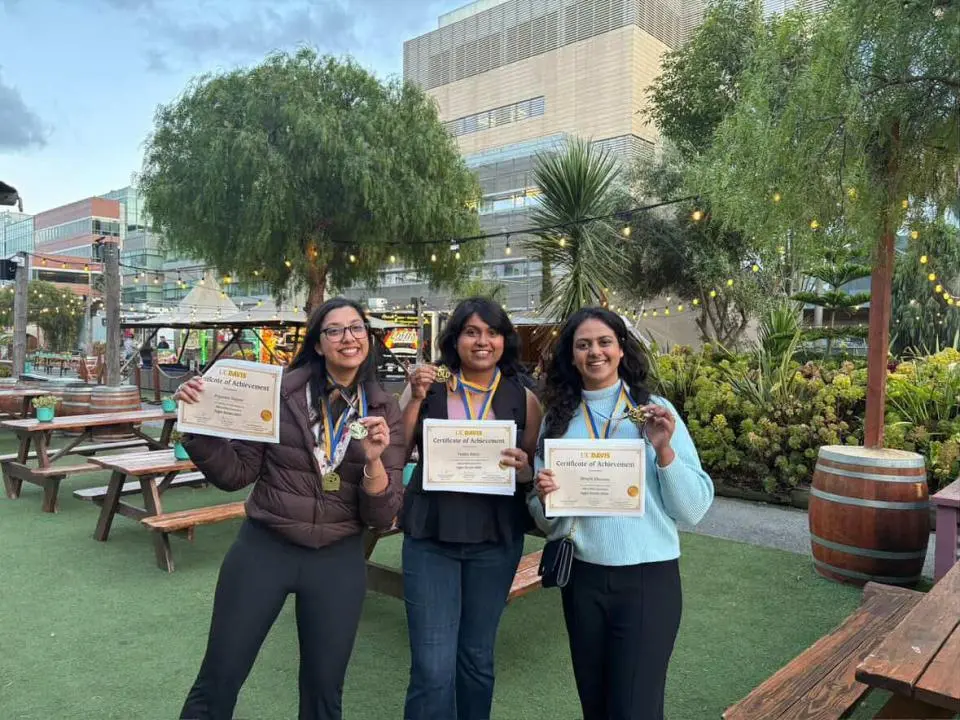
Nobody talks about the first hour of a hackathon. The part where you open the dataset, look at your teammates and collectively realize you have no idea what to do next.
That’s where we, Vedika Shetty, Priyanka Nayyar and Shruthi Khurana, found ourselves at Aggie Hacks 2026, the flagship hackathon presented by the UC Davis Graduate School of Management’s Master of Science in Business Analytics (MSBA). The event brought together MSBA and MBA students to solve real-world business challenges through data, strategy and storytelling.
The Challenge
Seven years of IRS tax filings, a prompt from Fairlight Advisors, a financial advisory firm serving nonprofit, and—for a while—nothing but a blinking cursor faced us.
The challenge seemed simple enough: Figure out which nonprofits need Fairlight most. But simple prompts have a way of unraveling.
One teammate wanted to start with segmentation. Another gravitated toward prediction.
For a few hours, those instincts competed more than they collaborated.
“Nothing about this was smooth. No direction at the start, tough feedback from judges halfway through, a full rework overnight. But it ended with 134 real nonprofits that stay open if someone manages their money, and that felt bigger than any trophy.”
—Priyanka Nayyar MSBA 26
What made this challenge different from a classroom assignment was the ambiguity. There was no clear starting point, no defined framework and no confirmation that we were even asking the right question.
The Reframe That Changed Everything

What broke the stalemate was a small, obvious-in-hindsight reframe: Stop asking what the data can do. Ask what would make someone confident enough to act on it.
Then the data started talking.
The median California nonprofit had about two weeks of cash on hand. Two weeks.
But buried in the same dataset were organizations sitting on millions in reserves, earning no interest on them. It was not for lack of options. It was for lack of anyone showing them what better looked like. Our team started calling them "sleeping giants." Cash-rich, strategy-poor. Exactly the clients Fairlight should be chasing.
That shift did more than clarify our direction. It gave us a story, a focus and a reason for every decision that followed.
What We Built in 48 Hours
Once we aligned on the problem, everything moved faster.
We built three tools:
- A segmentation framework to identify nonprofits with idle capital
- A machine learning model predicting seven-year survival based on financial behavior
- A stress test simulator answering a critical question: if everything goes wrong tomorrow, how long does an organization last?
One of the most surprising insights came from the model. Management quality mattered significantly more than cash reserves. That changed how we framed risk, and ultimately, how we structured our recommendations.
“Data is only as powerful as the story it tells. We leaned into our business roots to cut through the complexity and find the leverage that actually moves the needle. This win is our confirmation: We’re ready to lead where strategy meets tech.”
—Vedika Shetty MSBA 26
For 134 California nonprofits, the answer was clear: Many would not last long without intervention.
Taking the Hits to Come Back Stronger
First-round judging was humbling. The judges didn't question what the team built. They questioned what we assumed.
The two percent yield figure. The peer group logic. Uncomfortable questions. Also, as it turned out, the most productive ones.
Overnight, we:
- Reworked our assumptions
- Refined our benchmarks
- Built an adjustable shock simulator to strengthen our model
That second iteration was sharper, more defensible and more aligned with how a real client would evaluate risk.
What Aggie Hacks Teaches You That Classes Can’t
Aggie Hacks is structured, but the learning isn’t.
You work in teams of three to four. You have access to mentors. You present to judges who evaluate not just your analysis, but your ability to communicate impact.
But what you actually take away is harder to measure.
“We walked in with a mess of data and no clear question but walked out with a pitch, a win and two people I'd trust to figure out any problem with.”
—Shruthi Khurana MSBA 26
You learn how to:
- Navigate ambiguity without waiting for direction
- Align quickly with teammates who think differently
- Translate technical work into business decisions
- Defend your thinking under pressure
That combination is what makes the experience feel real.
The Outcome
We took first place with $3,000 in prize money. But ask any of us what we’ll remember, and it probably won’t be that.
It’ll be the late nights. The debates over which number deserved the headline. The moments where something didn’t work, and we had to rebuild it—fast.
Hackathons compress months of collaboration into hours. That compression leaves a mark.
Winners: Aggie Hacks 2026
Grand Gold Award – Team F1-2-H1
Also awarded: Best Storytelling | Sterling Silver Award – Team RAV
|
Bronze Brilliance Award – The Data Gamblers
Also awarded: Best Mixed Team (MBA + MSBA) | Best Presenter
|
Related content

We Built an AI to Outsmart Disasters — And It Actually Worked
Engineering the future of emergency response in 48 hours

MSBA Students Build AI Tools to Save Cities in Hackathon
Virtual 48-hour Aggie Hacks pushes students’ skills to the limit

What Does an AI Engineer Do?
MSBA alumnus Kshitiz Parashar shares insights on compelling, impactful AI career path