Trump's Proposed National AI Framework Faces Uphill Battle
UC Davis analysis uncovers how states are already shaping AI’s future
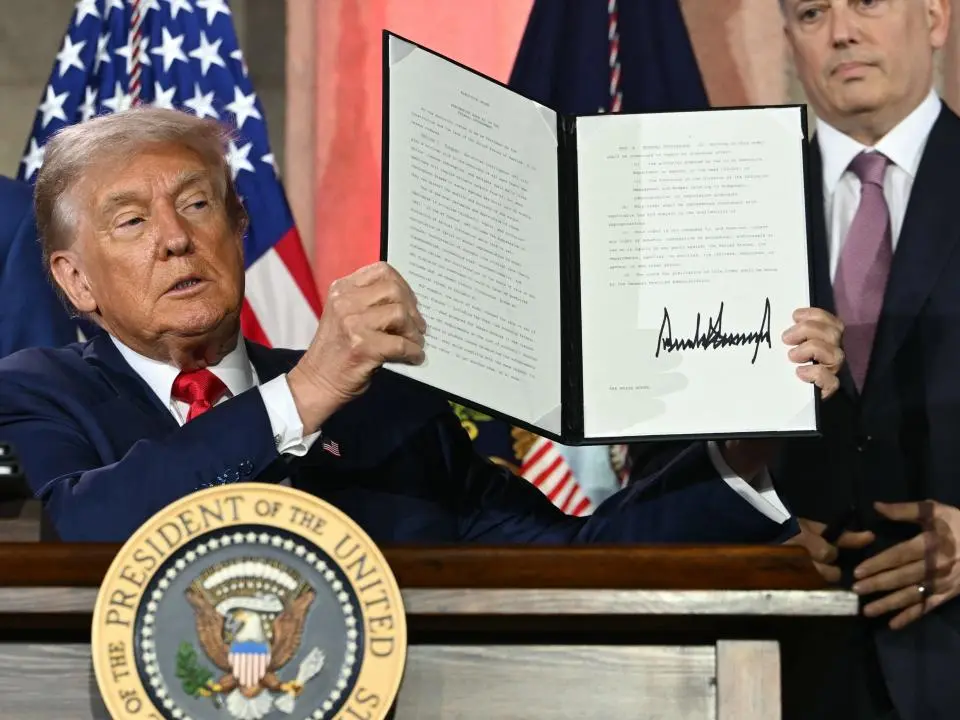
President Trump's recent executive order that blocks states from enforcing their own AI regulations faces an uphill battle. His order claims excessive state regulation will thwart innovation and result in a patchwork of 50 different regulatory regimes that makes compliance more challenging, particularly for start-ups.
Yet that train left the station long ago, with states leading the way on AI-related legislation for the past five years.
For example, California recently passed a landmark bill, seemingly positioning the state at the forefront of AI legislation. The first-in-the-nation AI Safety law, SB 53, the Transparency in Frontier Artificial Intelligence Act, signed into law by California Governor Gavin Newsom, went into effect on January 1.
The new law requires AI developers to publicly disclose their safety and security protocols, while also creating a way for companies and the public to report major safety incidents to the state. Public disclosure of security protocols is not even required by the EU AI Act, which stands as the landmark piece of AI legislation for the time being.
As Politico reported, the California bill was “the result of months of intense discussions” with the AI industry, including tech luminaries and Silicon Valley AI heavyweights Meta, Amazon, Google, OpenAI and Anthropic. The law is now being watched by Congress and other states as an example to follow. With California home to the global hub of AI innovators, it would make sense that the Golden State is the nation’s legislative leader.
But is California truly leading on AI legislation? And, where does the U.S. stand broadly on state regulation right now as federal policy looms? The landscape is still incredibly ambiguous to customers and corporations alike.
The reality is that there is a lot more to the story.
The Politics and Patterns Behind America’s AI Laws
At the Center for Analytics and Technology in Society (CATS) at UC Davis, an initiative within the Graduate School of Management, we provide thought leadership and practical insights into the use of analytics and technology in society, especially health care, media and entertainment, and platform businesses—including the impact of AI.
Our latest research examines the landscape of AI legislation in U.S. states over the past five years.
The National Conference of State Legislators (NCSL) provides a database of AI bills from all 50 states. On the face of it this is an incredible value and resource given that legislation is so fragmented.
However, our analysis shows that nearly 400 of the 1500 bills in this NCSL database have nothing to do with AI, and their categorization was not useful.
Narrowing the NCSL database, our team has classified more than 1,100 state bills that do impact AI. Our in-depth analysis shows which states are drafting bills on what AI topics, their timeline for doing so, and their success in enacting legislative proposals into law.
Of 1,116 AI-related state bills introduced between 2020-2025, 175 have become laws, and at least 40 states have passed at least one AI bill during that period.
We’re exploring the political, demographic and economic factors and how these factors shape AI regulatory efforts and outcomes.
What’s Driving AI Legislation?
These five core questions are guiding our analysis:
- How much AI legislative activity exists, and where is it concentrated?
- Are states converging toward common approaches or diverging?
- Do states influence their neighbors’ AI policies?
- What bill characteristics predict passage?
- How long do bills take to pass, and what factors speed or slow enactment?
A review of the data shows that most legislation is about AI funding and economic development, product safety, and institutional frameworks for AI governance.
We have also found major differences between blue and red states based on political control. Blue states focus on funding and economic development, red states (and split states) focus on product safety.
While Democratic-controlled states New York, New Jersey and California have introduced the most AI-related bills, many of these bills get stuck and are still pending. In fact, Texas, Maryland and Georgia have passed the most AI legislation over the past five years (43 laws total), but California is not among the top 10.
Our preliminary results show that:
- Neighboring states’ enactment of legislation significantly predicts their own behavior, thus a “keeping up with the Jones effect.”
- States split roughly 60-40 between substantive regulation and institutional frameworks, with individual states varying dramatically.
- Time-to-bill-enactment has substantial variation, with a range of 4-18+ months and a median time of 10 months.
We’ll continue to survey the influences that affect successful passage of proposed legislation at both the state and federal levels.
These research insights are valuable to policymakers in formulating laws and policy for the use of AI as well as informing corporate leaders. The rate that AI is growing, both technologically and economically, is truly unprecedented.
Our work at CATS and others who are looking into effective legislation is crucial to fortify the country’s presence as an AI leader.
Related content

AI Legislation in the U.S.: A Descriptive Analysis
Professor Hemant Bhargava and CATS team examine how states are shaping AI’s future

When More Means Less: The AI Pricing Paradox
Professor Hemant Bhargava explores the future of AI economics

MSBA Students Build AI Tools to Save Cities in Hackathon
Virtual 48-hour Aggie Hacks pushes students’ skills to the limit