From UC Davis to the Airline Industry’s Front Lines
Maurice J. Gallagher Jr. on leadership and aviation
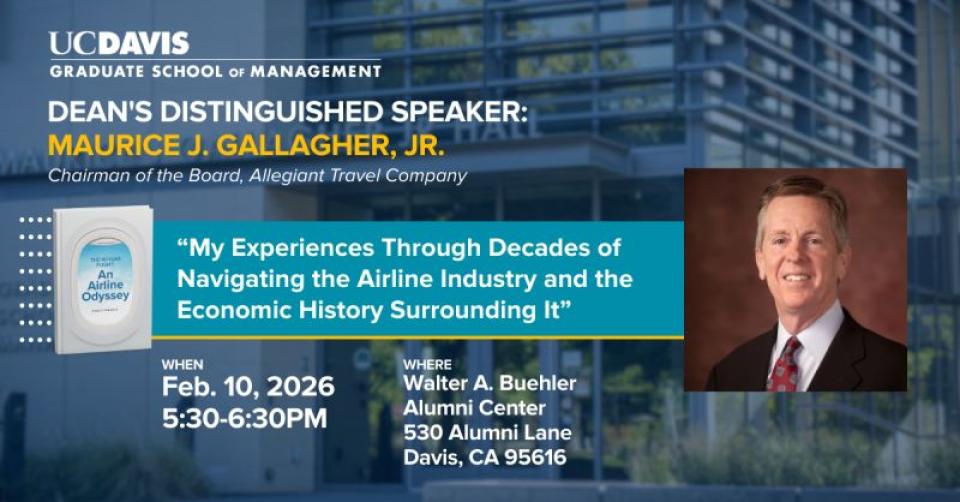
Maurice J. Gallagher, Jr., UC Davis alumnus and chairman of Allegiant Travel Co., returned to campus as the featured guest for the Graduate School of Management’s Dean’s Distinguished Speaker Series.

Gallagher, whose philanthropic support helped establish Gallagher Hall — the School’s home and collaborative hub — spoke to students, alumni and faculty about the forces that reshaped aviation and the U.S. economy since the 1970s.
A true airline industry maverick, Gallagher transformed Allegiant into a niche travel agency with wings. A recently announced $1.5 billion deal to acquire Sun Country Airlines would further expand its reach.
Speaking to a standing-room-only audience, Gallagher traced his 40-year journey from airline deregulation in the late 1970s to building three ventures—WestAir, ValuJet, and Allegiant. He shared candid lessons on risk, innovation, resilience, and navigating industry turbulence and tragedy.
He described how deregulation opened the door to aviation entrepreneurship, how ticketless travel reshaped distribution systems, and how Allegiant’s leisure-focused, low-cost model redefined value creation.
The talk concluded with a Q&A exploring automation, sustainable aviation fuel, airline economics and the future of air travel in an increasingly complex global landscape.
He also signed copies of his new self-published memoir, "The 40-Year Flight: An Airline Odyssey," continuing the conversation beyond the stage.
Video Transcript
H. Rao Unnava, Michael and Joelle Hurlston Dean and Professor of Marketing
Good evening, everyone. I’m Rao Unnava, dean of the Graduate School of Management. Thank you for joining us at the Graduate School of Management in honor of the Dean’s Distinguished Speaker, Maurice Gallagher.
Maurice graduated from UC Davis in 1971, and his journey from then on is the basis for the book he just published book, "The 40-Year Flight: An Airline Odyssey."
We will end this event at about 6:30 p.m., and he will sign the book for anyone who is interested in picking up a copy. Instead of introducing Maurice once again and repeating the information we already shared with you in the invitation, let me say a few words about the book — because it says a lot about Maurice that goes beyond his business acumen and success.
The book starts with the major changes that took place in the airline industry right after deregulation. It’s when entrepreneurs like Maurice found opportunities to feed their passion for flying while making a living. Having seen the changes in the airline industry but not really understood the motivations behind those changes, this book, to me, was a second journey through time that made a lot more sense than the first time.
We start with Maurice’s creativity — the dots, various pages in the book, for example, when they needed new airplanes but didn’t have the cash. They gave employees an opportunity to invest in planes, get some tax credits out of that and stock, and use the leftover cash to fund the working capital of the airline. It highlights Maurice’s persistence in the face of adversity.
Just 40 years ago, he writes about the difficulty of raising $50,000 to buy WestAir because he was completely broke — and so was his partner. He talks about how they spent late evenings and weekends building furniture for themselves because they didn’t have enough cash to buy new furniture.
We learn about unexpected events that would have deterred anyone from continuing in their business — as when air traffic controllers were fired by President Ronald Reagan, causing smaller airlines to take a major financial hit.
Or when the San Francisco airport suddenly decided they wouldn’t allow BAC-111 aircraft, which Maurice’s company owned. Or when the FAA suddenly stopped them from flying the San Francisco-to-Los Angeles route after telling them they were approved. Or the ValuJet tragedy.
Maurice plowed on through all of these events — and with humility, he recognizes the role luck plays in business sometimes, as when feeder airlines went out of business in California, which opened up the market for WestAir.
His humility comes through almost on every page of the book. He gives credit to so many people who were his fellow passengers on this journey. At one point, he says, “I have often commented that I felt behind my peer group in maturity and sophistication during most of my career, particularly with respect to social skills.” He calls it as he sees it, and you experience that throughout the book.
Finally, I endured certain expressions I had not used in a while in my own writing — like someone “getting long in the tooth,” as he uses in the book. Or, “You either get better or you get poorer.” These expressions, and several humorous anecdotes, make you feel that Maurice is directly talking to you throughout the book.
All right. Thank you for sharing your knowledge with all of us, for your generosity in supporting UC Davis, and for simply being who you are. Thank you.
Maurice J. Gallagher Jr.
Good. Yeah. OK. Well, he gave my speech for me. What am I to do?
I have a great deal of affection for this part of the world. I came to this campus — actually, I was transferring to one down the street a bit, in San Francisco — in 1969, when my parents moved to the Bay Area. Everybody in Illinois wanted to go to California because the Beach Boys told us this was where we had to be.
So I came out here in ’69 and didn’t know a soul, and ended up in a brand-new apartment with a couple of roommates. One was from Haiti. “Sushi Louis,” I remember him. Another was Gavin Government — and he was from, I think, Armenia or something. That was my introduction to Davis, with two new roommates.
From there, it was a great two years. I spent another year afterward here. I was fortunate enough to have a bad back, and it kept me out of Vietnam. So I ended up finding that out — it was January or August of ’71 — when I was going to law school, as we all did.
I stayed around here and ended up as a college basketball referee. This is a great home and great times.
I knew I needed to go back and get another degree because I was a history major — and I still, to this day, am a history major.
I chastise all you youngsters in the room: You have to read. You have to keep up with the world. If you don’t, it’ll pass you by.
What you’re going to see here is a segment of history that I’ve lived through, but it’s really indicative in many ways of the U.S. economy and what’s happened in the last 50 years. It’s been the most transformative time in the U.S. economy — and the world economy. If you step back and look at it, the airline industry was part and parcel of the whole deregulation of the world.
Let’s see if I can get this to work here.
Come on. All right. I’m going to have to improvise.
It’s not working. OK, I’ll come back and do it.
A little background: This is the economic history. Some of those are the three carriers I’ve been involved in during the years, and some topics involved in that. Then I want to mix in a little bit of history and some economic history as well.
I spent the 1970s just kind of wandering around — couldn’t get a job. Those of you that lived through the ’70s knew how tough it was. People think this inflation period, the last five years, was tough — live through the ’70s. Inflation and interest rates at 21% for short-term money by 1980, and housing mortgages at 15%. Inflation in 1980 was 14%.
Paul Volcker comes along and puts the squeeze on, and the world starts turning around. That squeeze was the start of the greatest accumulation of wealth in the history of mankind. It really kicked it off.
I’m very curious as to what caused all this wealth creation right now. Why now in history? Why not in the ’50s or ’40s?
I think you can look to one of the keys — regulation in the 1920s. You never hear people write about it. It’s kind of an out-of-sorts period with economists and historians. But they had a 40-some-percent growth rate in the 1920s. All these new technologies came together — motor cars, electric. Factories got incredibly more productive. All that stuff was available in the ’20s. But then, of course, you had the Great Depression.
And as you can see, that bottom line of Franklin Roosevelt’s famous quote was: You can’t trust business to run something so important as our economy.
So you end up with these regulations you see. Glass-Steagall. The CAB. The Civil Aeronautics Board was created in the ’30s. Trucking, airlines, the Securities and Exchange Act. Government becomes “the wise people on the Hill.” They have to tell us what to do.
You go through the ’40s — World War II — and then the ’50s. By the time you get to the ’70s, you’ve got AT&T and the FCC, where AT&T is a complete monopoly. Guess what? AT&T can hire much brighter people than the FCC could. So people finally figured out the FCC wasn’t running the FCC — AT&T was running the FCC. That’s indicative all through a lot of the regulatory stuff.
In the airline space, you had a couple of carriers start up — PSA. Those of you that lived out here, if you flew intrastate, the feds couldn’t cover you.
Southwest started in 1971 in Texas — big enough state where they could fly intrastate — and you had people with $15 fares making all kinds of money. Meanwhile, all the regulated people: If you wanted to change your fare in the ’70s, you had to go to Washington, D.C., with your lawyer, your economist — just to change a fare, let alone get a route.
The whole route structure and development of the airline industry: If you could fly, you were a rich person. I remember flying on an airplane and my mom had me in a little coat and tie. It was the luxury way to travel. It was not meant for the average person — and that was the time of the bus industry.
More importantly, people stayed closer to home. You had your concentration of community. So you take a Greyhound or a Trailways. And the old joke about anybody coming down the road — now it’s just a dog — and after they get hit, it goes, “Yeah, Greyhound.” Younger people don’t get that one.
The trucking industry was being regulated. You had price controls by President Richard Nixon in 1972 — old oil, new oil — disintermediation. As interest rates rose, people would take their money out of the banks and throw it into savings and loans. Banks were sitting there upside down because all their capital had left them.
Finally, there were intellectuals writing articles saying, “Is regulation really what this government should be doing?”
So you start having deregulation — President Jimmy Carter — and you would think that Republicans would be the ones doing it. In fact, they were not. It was Ted Kennedy who really fought for airline stuff. One of the few industry or government agencies that got taken down was the CAB — sent to the backyard — and they brought on the DOT.
This took place starting in the late ’70s and into the early ’80s. Trucking, airlines, oil, banking — you took care of the interest rate caps. Now all of a sudden, here’s the U.S. with this ability to go do things without saying “mother, may I?” to Uncle Sam.
Put it together with the interest rate changes Volcker brought on. He was appointed by Carter in 1979, and he immediately attacked inflation by interest rates.
In inflation, you buy things — you don’t hold on to money. Go to Argentina or Brazil and see if you want inflation. I went down there to buy some airplanes in the 1980s, and people were walking around with wheelbarrows of money to buy food.
Inflation is critical to the success of an economy — but first you had to break the back of it. That happened in 1981.
Reagan was elected in 1980, and he suffered through a recession through ’81 and ’82. But what happened in August 1982 — I never forget this — the stock market on about Aug. 12 had a World War II headline: “Dow up 36.” That’s a rounding error today.
Go back to 1968-69 through 1982: The Dow literally touched above 1,000 two or three times. It was 700. It was 777.
On that day, they went back and checked. We were able to take a company public a month later. That was a terrible company, but the market was able to absorb it and do things that had not been done or seen in years.
That was the start of what you’re seeing today. It’s had its ups and downs. In 1987, you had a big crash. We recovered quickly. What you didn’t recover quickly from was 2006-07-08, because that was a debt crisis — not an equity crisis.
From 1982 on, the marketplace has produced an incredible amount of wealth. I think deregulation is the backbone of where we are today.
Mind you, the world had to follow. When the U.S. starts flying over there using airplanes, if you’re not allowed to come and go the same way, you’re getting behind the power curve.
The Dow — that’s the latest number — it’s 50,000. It’s staggering. I’m not sure what you do with that much money, but you’re starting to see this wealth change the way people do business. People are buying sporting franchises. They’re paying $6 billion for the Boston Celtics. They’re paying $10 billion for the Lakers.
My analogy: It’s like the bear and the salmon in the stream. The biggest bear is standing over the top of the stream. He gets first choice of salmon. Well, guys on Wall Street went in there in the ’90s and started doing private equity and those types of things.
They’re now in their early 50s or 55, and they’re walking away with the “B” behind their name. They’ve got to do something with that money.
I know a gentleman who’s got an auto manufacturing company. He rebuilds huge Porsches and charges $3 million for his Porsche. That’s the kind of stuff happening today.
In the airplane business, leasing companies today that are buying and selling and trading airplanes are owned by private equity firms. What better asset, if you have lots of money, than a $50 million, $60 million, $70 million Airbus or Boeing? It’s mobile. It’s not glued to the ground.
My career: In the 1970s, I floated around. I did a little accounting for a couple of years. I knew I would never be a CPA and never took the exam. It wasn’t my cup of tea.
I ended up at a company called Itel in 1978. Itel was the man of the hour in leasing in San Francisco. They passed the deregulation act for airlines in 1978 — October.
I look back on my own career — you always have these interesting things that move you.
I remember my dad taking me down to the airport in Kansas City, where we lived, and watching airplanes take off. I was fascinated.
I was driving an asphalt truck. I was 19 years old in Chicago. We’re on the O’Hare airport runway extension, and the 747 was new — ’67, ’68 — a massive airplane. Here it goes, taking off over the top of me. It’s like a shadow just sat there. Then you look up and you’re looking at the belly of the airplane. It’s 200 feet above your head and you’re going, “OK, that’s impressive. How do you do that?”
Those things stuck with me.
In 1979, a fellow I was working with had come from Hughes Air West. Another friend of his he knew. The three of us left in July of ’79 to go into the airline business.
We entered an ad in a newspaper — if you can believe — looking for an airline management team. OK, that’s us.
I couldn’t spell “airplane.” I knew one when I saw one, but that was it.
We showed up in Santa Rosa, California, for this little company — a startup, a function of deregulation. It was so small and backwards. The way we took reservations: You put it on a table — a daisy wheel — and if you called for a reservation, we’d pull the card for the date you’d fly and write your name down. No electronics. The company was a perpetual money loser.
We got there, we knew we needed money, and I was the finance guy. I raised venture capital — went to New York — found $1.5 million from a firm. We closed in October 1980. That was to launch a jet airline and also this commuter airline.
“Commuter” means small airplanes. “Jet airline” means jet airline. The commuter business was small cities feeding into bigger cities — so the Chicos of the world could have service.
We kept going as a money loser. I’m blessed that I didn’t worry about it. We were bankrupt multiple times. Didn’t know where payroll was coming from.
There’s a sale-leaseback transaction in aviation today. We invented that back in 1979.
Part of the reason: You had investment tax credits. We were able to sell a lot of these airplanes — oversell them — take the money out. That was our working capital. Not a long-term business success story, but it got you from here to there.
Fast forward: In 1982, we raised another $6 million. We brought a CEO in because our white hair wasn’t white enough at the time. We were ready to launch Pacific Express.
Rao talked about the controllers. Reagan fired the controllers on Aug. 1, 1981, when they went on strike.
Every airport in the country became a slot-controlled airport. You couldn’t just go fly — you had to file your schedule.
A great anecdote: We filed a schedule in September for a February launch. It came back: “Your schedule has been approved.” Great.
A couple weeks later, our chief operating officer is talking to an FAA guy and bragging. The FAA guy says, “Let me see this.” He looks at the telex — shows you how long ago it was — and they left out a key word: “not.”
So there we are: L.A., San Francisco, flying Chico, Oakland, Palm Springs. Ain’t exactly your prime marketplace.
We divided the commuter business — the small airplane — and then we had the jet business. The jet business was a terrible business. Shouldn’t have been put together. Bad business plan. You name it.
My partner and I figured it out. By October ’82, we went public. They fired the chief executive officer, kicked him upstairs.
The new guy running the jet business wanted to get rid of it. My partner and I talked him into it. We had to raise money.
We had to get a guy to give us a $50,000 letter of credit. Then we had to come up with $50,000. I didn’t have two nickels to rub together. We talked a banker friend into a $30,000 signing note. My sister lent me $10,000. We each put $5,000 on credit cards. That was us — broke.
Back then, what you had to sell was time. Late 20s, no family. That’s when you do that kind of stuff. We closed the deal in January 1983, and our timing was perfect.
There was no hub-and-spoke business model before deregulation. Hub-and-spoke means you bring things into a central area — crisscross efficiency — and go out.
FedEx: Fred Smith started FedEx in 1973. He went to Memphis — center of the country, good weather — build a hub. Virtually every Federal Express package goes through Memphis to be exchanged.
The hubs started coming in 1979 and after. Chicago, Dallas, Atlanta — fabulous hub city.
They needed people to feed their hubs. Out here, San Francisco was a United hub. We were the little guy up in Chico. Everybody else was failing. Deregulation was working, right?
We went up with little airplanes, got involved with United in 1984, and we went from a couple-million-dollar business to that.
That’s a lot of numbers, but the right-hand column has big percentages — 1985 to 1991-92. We grew to be the biggest commuter in the country. It was out of control. I was the finance guy. Working capital was running over the top of me.
We left all our working capital because of the way the system worked with United. United got the ticket money, and we as the commuter didn’t get paid until later — like a 50-day receivable. As we grew to $300 million, all our money was sitting in United’s bank account.
In 1991 came the Iraq war. Aug. 1, oil was 75 cents a gallon. Aug. 2, it was $2 a gallon. Instantly, business was in trouble.
We managed to save it. We did hard things. We sold off pieces. We finally sold the business in June or July 1992.
I was done with California. Fed up with the rules. Great place to live, great people. I moved to Las Vegas and was interested in doing something else.
I had a very good friend and partner, Robert Priddy, who started Atlantic Southeast Airlines in Atlanta. He had sold it out. We felt there was an opportunity.
We met a fellow named David Neeleman — JetBlue and now Breeze. David is still at the top of the list.
Priddy said, “I want to go to Atlanta” — take on Delta in their hub. Eastern had failed in ’91-’92. The C concourse had closed — 40 gates.
The No. 1 variable in the airline industry is real estate. If you can’t get a gate, you can’t fly.
Those 40 gates were a tremendous opportunity.
We started off with this company. My deal was: I wasn’t going to do this unless I could put my automation in.
Ticketing was all paper. You had the travel agency, the airline, the customer. You’d walk out with four tickets. Coupons would get pulled as you traveled. You’d have to touch it at the front end and touch it again when the ticket got pulled.
One of the things we invented was ticketless.
A fellow who worked with me in Fresno built our operational system. When we went to Atlanta to do ValuJet, he wrote the front end.
We started out with a fully ticketless system. You called up, we put your name in the system, we cleared your credit card. You showed up and said “Gallagher,” we hit the “G” button. The manifest was already there.
Accounting was all done. We had three people in accounting for a $10 million-a-month business. It was revolutionary.
ValuJet took Atlanta by storm. We did creative stuff. We talked about innovation. We were the first fully ticketless system.
The company had tremendous financial results. In the third full year, 1995: $368 million. We made $68 million after tax — unheard of in any business, let alone airlines. After three years, we had 51 airplanes.
We had an incredible cost structure because we were efficient. We figured out we didn’t need to fly every day. We didn’t fly on Tuesdays. Over the years, I’ve asked new hires, “How many of you want to start your vacation on Tuesday?” I’ve had one person raise their hand.
You fly when people want to fly — Thursday, Friday, Sunday, Monday — occasionally holidays.
We were off to the races, and then we had our famous accident.
Many of you know about it. It became big news, unfortunately. I’ll talk about safety in a minute.
We had an airplane on Saturday, May 16, take off from Miami and end up in the Everglades.
The people doing our maintenance down there had taken oxygen generators — chemical oxygen generators — and they are toxic. When you pull the pin, it creates a chemical reaction that’s 500 degrees. You use them once and throw them away.
They changed them out. They were laying on the floor. The supervisor says, “What’s this?” “Belongs to ValuJet. We’ll get it out of here.”
Every chance they had to do it right, they didn’t.
There are special things you do to deactivate them, package them. They threw them in a box, walked them over, and put them in the belly of our airplane.
We probably should have looked more closely, but we didn’t open it up — we didn’t know what they were.
The airplane takes off. Things heat up. They’re sitting on a tire. Smoke in the cabin. It takes the crew out.
One hundred ten people were killed. A terrible tragedy.
Let me talk about safety. This is the curve for safety in the airline industry — 1970s on the left.
Three things: maintenance, pilot error, and other. Pilot error is the No. 1 cause historically.
One famous one: A DC-8 going into Portland, Oregon, in 1978. Landing gear light didn’t come on. The captain kept his head down, trying to figure it out. Engineer is saying, “Sir, we’re running out of gas.” The pilot ran the airplane out of gas.
What did they do then? CRM — cockpit resource management. People are equals in the cockpit. The idea that the captain is a god: You have to be able to talk.
It turns out in some cultures, that’s difficult. There have been accidents where the copilot is afraid to talk to the captain.
In this period of 1994 to 1997, there was an aberration — 10 accidents. From 1994 to 1996, 750 people were killed.
The only company that got taken down was ValuJet. We were in that 1996 period. It was political. We couldn’t get off the front page.
The company went out and bought AirTran. We rebranded it. That company got sold to Southwest in 2010 or 2011 for about $1.3 or $1.4 billion.
It was still a successful company, but certainly not what it was before the accident.
If you think travel is unsafe, the numbers say otherwise. Safety is the only thing we sell. If we don’t have the public’s trust, they’re not getting on an airplane.
The industry works together — everybody — to make sure of it.
Next generation: Allegiant.
That gentleman on the left there — the heavier-set guy — that’s Mitch. Mitch loved airlines. It’s a curse.
He started Allegiant in the mid-1990s, and God bless him, he didn’t know how to do it very well. But he could start it, and he did it.
He was in Fresno, where I used to live and where he started the company.
My partners gave me nothing but grief when I got into this.
He bought some airplanes from Boeing Finance. Hush kits — Stage 3 — came in around 2000, and you couldn’t fly if you didn’t have it. Boeing was going to give him the money, and of course they didn’t.
So I gave him some money. By the end of the year, he wasn’t doing well. He put it into Chapter 11.
I was the biggest creditor. The world started coming apart in early 2001. I talked to a couple guys I knew. We decided to go after it. We took it out of bankruptcy July 1.
A couple months later: 9/11.
Every event happens for a reason. While 9/11 was tragic, it was the best time to start an airline — airplanes became very cheap. That MD-80 that was $180,000 a month became $80,000 a month.
Pilots were available. Everything was less expensive. Everyone was trying to regroup.
We wanted to be different. It was all my money, and we had to make money right away.
This is one of the most expensive businesses around to start up. David Neeleman started JetBlue and raised $170 million. We probably put $3 million into this to get it going.
So, never mind building your own tables and chairs. This was all over again.
The key: I want to do everything different. If everybody’s over here, I want to be here.
If you’ve got a pizza shop on the corner — Joe’s — he’s been there for years, clientele. The idea you can go across the street and beat him in his own business — not that you can’t — but it’s arrogant.
So our belief was to go after the leisure customer. Our focus was cost.
How do you reduce cost? Scheduling. Hub and spoke.
Marketing wants you to park airplanes in Bismarck because it’s best for selling. But how do you get maintenance people to Bismarck? Parts? Pay overnights for crews?
So we moved all that to Las Vegas.
Today we have 23 bases. Crews are home every night. If you’re American, Delta, United, you’re doing three- and four-day trips.
That’s attractive for us.
We were profitable from the get-go. We went to small cities — isolated — people couldn’t get out. You’d pay $800 to get out. We take you out and back for $200. We stimulated the market.
Trip to Vegas became affordable. We sold hotels. Automation made packages possible.
We changed pricing. Back then, low fares meant buy two weeks out, or stay over a Saturday. In May 2002 we changed that — everyday low fares — and traffic exploded.
We played with the model through 2004. It was cash flow positive. Nobody was coming in on top of us. We could make it work.
By 2005, we started in Florida. Then this is us today: 125 airplanes. A $2.6 billion company. We fly about 20 million people a year. It’s a real business.
Having said that, we’re a rounding error compared to Delta — a $55 billion, $58 billion business.
I’m very proud of this.
I was the CEO until two or three years ago. One of the most interesting things: I’d never been in a big company. I didn’t know how to run a big company. I made a lot of mistakes.
But I stayed at the helm and stayed with it. In many ways, that’s my most crowning achievement — staying on top of a company that got that big. It was a lot of fun. Still is.
I’m still the largest shareholder, and I’m chairman of the board. I joke: I can spell “airplane.”
I’ll probably write another treatise like this because the industry is going to change in the next few years.
This is the history of Spirit and Frontier, if you’re familiar. 2019 is a seminal year. Spirit and Frontier grew like a weed. They tried to conquer the world. They took in sale-leaseback money. Accounting rules changed in 2019. Their numbers look better than they are without that benefit.
Spirit is all but dead — in bankruptcy. They own nothing. They have no home.
We have a map. Those are our homes. We’re doing nonstop flying. We’re different enough.
They tried to imitate the majors, and the majors are taking them to the woodshed. You’re going to see a dramatic change in the next three, four or five years.
We announced a merger with another small carrier. Together we’ll be a $4 billion company. We’re profitable — most profitable percentage-wise in the industry.
Fares are going to get expensive. They’re not cheap now. They’re going through the roof.
I used to think Southwest was low fares. Not anymore. You’re going to pay for bags on Southwest.
You’re going to end up with four big guys. You came out of deregulation with big carriers. Others came and went — Pan Am, Eastern.
You’ll end up with Delta, American, United. Consolidation happens when you can’t keep growing.
You can’t raise fares the last six years? Frontier’s numbers in 2019: they got $110 a passenger, spent $100. First nine months this year: spent $126 and still got $110. How do you crawl back from a $15 deficit? These are big businesses with big cash requirements.
Politics will be interesting. But you get back to full regulation where it’s expensive to fly.
Labor is a problem — pilots. Unions in Washington, D.C., are powerful. A 12-year pilot at Delta, American or United is making $370 an hour on a narrowbody. That’s a $400,000-a-year job, working 150 to 170 days a year. Great gig if you can get it.
Maintenance is hard and expensive. LAX is $50 a passenger to transit. Low-fare carriers can’t pass on $50 easily.
In 1975, there were 180 million people in the country and 150 million people flew last year. Now we have about 340 million people. A stimulative factor is gone. We relied on stimulation — lower fares — to get people off the couch.
Airplanes are an oligopoly. Engines are an oligopoly. They’re expensive. A low-fare carrier can’t afford to buy a new airplane.
I don’t want to be a Debbie Downer. From a parochial perspective, we’ll be in good shape. The country’s generating incredible wealth.
Maybe people will come along and start a new carrier, but the last few startups have hit the wall.
One thing I want to do going forward: examine why we’re so successful as an economy. Did deregulation really trigger it all? Interesting questions.
With that, I’ll stop. I’ve been told it’s over.
Thank you.
Audience Member
I’ve got autonomous flying. Electric flying — what are your thoughts?
Maurice J. Gallagher Jr.
I’ll address it another way.
Electric flying — the idea that people are going to take electric and make it work — is a nonstarter. If you wanted to turn off gravity, you might be able to do something.
The nice thing about airplanes today is when you put fuel in the base of the airplane, it burns off — so you get lighter and can go further. Electric never gets any lighter.
When you take it to 30,000 feet, electricity storage doesn’t go well.
Then you get to the gate — what do you do with that massive battery? Drop it down and change batteries? Where do you plug it in? Who’s got the electricity to bring to major metropolitan airports?
Regarding autonomous flying: Yes, I think as expenses go up, the way you counter expenses with pilots is autonomous systems.
We’ve been doing autonomous flying for 30 years with the Air Force — drones and things like that.
It wouldn’t be hard to build a single-pilot airline airplane. Take that captain and put them on the ground, and he or she watches six or seven flights. If there’s a problem, they can intervene.
That’s a dispatch function. Every airplane is being followed by somebody on the ground working with the pilot. To have somebody do that would not be a big leap.
Labor will fight like crazy against it. But a 55-year-old captain tired of three-day trips might like an eight-hour shift on the ground.
Nothing on the drawing board today — I shouldn’t say that. Some small companies are improving things, but it’s a tough political battle.
Here’s the problem: That horrific accident in Washington, D.C. — there’s a landing zone and helicopters crossing it. It only takes one event.
Now they’re talking about airlines spending $1 million to upgrade avionics. There’s $4 billion somebody wants to deal with.
Affordable Skies — young lady with me today, Jennifer — she’s running that, which I pushed her to start. You’ve got to stop regulation that comes along in the name of safety without considering costs.
Safety — you can’t knock safety. But what goes on inside a cabin: If you want a bigger seat, you’ve got to pay for it. You can’t legislate it without hurting the economics.
Audience Member
Thanks for the talk. What are your thoughts on sustainable aviation fuel and how the industry will change?
Maurice J. Gallagher Jr.
We consume 220 million gallons a year of jet fuel, and we fly 1% to 2% of the ASMs — do the math.
There’s a standard for jet fuel. It’s the same all over the country. The magnitude of trying to change that is enormous.
Our average price was $2.50 a gallon. You’re talking $7 or $8 a gallon.
These systems have been in place for 100 years — 150 years. You don’t just flip a switch and say we’ve got to do this.
Who’s going to pay for it?
It makes people feel good, I guess, but it’s not practical to do it and maintain the system as it is today.
It won’t happen in my lifetime.
Frequent flier programs and economic impacts — that’s interesting.
Bob Crandall at American in the ’70s and ’80s developed the frequent flier program. Greatest marketing tool ever invented. Somebody else pays for your benefits.
You work for a company, you keep the miles, the company pays for the miles. Genius.
Now you have partnerships between banks and credit cards. AmEx with Delta. Chase with Southwest and United. American — I forget who they’ve got.
You go through their balance sheets: American has $10 billion on liabilities — cash in effect.
There’s turnover where banks buy miles for customers. Then you get lounges and facilities. Delta has done an incredible job.
Lounges got so popular they’re regulating lounges.
You can fly airplanes at break-even because you make money on credit cards.
There’s been regulation efforts, but it’s powerful.
Delta’s unit revenue is about 19 cents per mile. Ours is 12 cents. We need a better cost structure.
Delta makes $5 billion or $6 billion a year after tax — they can buy 100 airplanes. We make $300 million or $400 million — we can buy five airplanes.
They’re an incredible machine.
United’s right there. American has problems — talk of a palace coup.
These guys are big and dominant. Delta does a great job — on time — strategic move.
Basic economy: they take 60 seats on a 200-seat airplane and put Spirit/Frontier pricing on them. So you get the Frontier experience, but you’re on a Delta airplane.
Then they take every customer and never let you make a profit — you bleed to death.
Other questions?
Audience member
On jet engines — Allegiant is investing more into the 737 Max platform. Any concern about growth limits and retraining pilots?
Maurice J. Gallagher Jr.
Airplanes get too big. Gates are crowded because they were built for 127s and DC-9s, and now everybody has 180-seat airplanes.
Frontier’s buying 240-seat airplanes. Turning a 240-seat airplane in an hour and 15 minutes — filling those extra seats on a leisure carrier flying two-hour segments — you just can’t.
The max we do is 180 seats. That’s as big as I think we should go — maybe smaller.
The 737 is a 1960s design fuselage. Airbus is newer — 1980s. Boeing played catch-up.
But the airplane’s reliable. Like buying a Ford or a Chevy — parts, maintenance, everyone knows what to do.
Fuel burn: 20% to 30% savings because of new engines.
Audience member
How do you see the airline industry — a tough industry being run by great people?
Maurice J. Gallagher Jr.
Airlines are kind of a cesspool. Airports need us — there isn’t another airport down the street.
Airplane manufacturers — only two. Engines — few. Parts suppliers. Financiers. They all need us.
Over the years, they’ve kept carriers alive. GE keeps airlines alive.
Warren Buffett wrote a classic line: They should have shot Orville and Wilbur on their way to Kitty Hawk.
He also said: You buy the same machines, go to the same airports, buy the same food, deal with the same unions. It’s capital-intensive to a fault.
Why get into the business? I didn’t know that then. I was committed.
I’ve been fortunate. Every airline I’ve been in has made money. Never filed Chapter 11.
I’ve been a good steward of investors’ money and my own.
You have to pay attention and stay inside your envelope — know what you are and stay there.
I might be the wealthiest airline person because I held onto my stock. Most airline people sell early.
Stay tuned.
Audience Member
Southwest has backlash from changing its model. How does that end for them?
Maurice J. Gallagher Jr.
With a balance sheet like Southwest, they’ll be fine. People have short memories.
People buy tickets for schedule — leave at this time, come back at this time.
Elliott got involved because the stock got low. The whole industry is on a rally.
We were at $50 a share four or five months ago. We’re $115 today. We’re back in favor.
Audience Member
Supersonic commercial planes — coming back?
Maurice J. Gallagher Jr.
Possible, if they can deal with the sound wave issues.
People pay for speed. Gulfstreams fly at 50,000 feet and about Mach 0.92. A 737 flies at 39,000 feet and Mach 0.76. Huge difference.
If they can fix the sound barrier issues, it’ll be interesting.
The 747SP was built to compete with the Concorde — similar trip time because it could fly forever with fuel.
We’ll see.
Audience member
Boeing — production delays and problems?
Maurice J. Gallagher Jr.
The FAA can’t keep up with the modern industry. Older workforce, not data savvy. We do everything with data.
Airbus came out with the neo — new engine option — around 2008-09. Boeing wasn’t ready and chased.
The certification process is huge. The accidents in 2018 and 2019: in many ways preventable, but training wasn’t what it should be.
Boeing made mistakes. It became political. They’ve got new leadership.
They moved away from Seattle to Chicago and started acting like a finance company — stock options, stock price rising.
Fundamental problems, but they’re not going away. They’re too big and too important.
Audience member
Managing people as a CEO — lessons?
Maurice J. Gallagher Jr.
As you grow, the job changes.
A vice president of maintenance with five or 10 airplanes is not the same job as with 50 airplanes. More management, more people.
At the top, people skills are most important. You have to inspire. You have to do one-on-ones. You have to deliver messages and get people to perform.
When they don’t perform, you have to make changes.
Small companies hit a wall at $300 million and $800 million because founders can’t keep up — they can’t deal with “Joe” who’s been there 15 years.
People have to respect you. You can’t be buddy-buddy with everybody. It’s a lonely job.
One thing I never did: time clocks or checking days off. I trusted people to get the job done.
It was enjoyable. We were industry leaders.
I used to tell them in 2005, 2006, 2007: “These are the good old days.” There’s nothing like building a young company and being successful. You don’t quite know it because you’re working hard, but you look back and go, “Wow, we were good.”
As the company grows, people have to grow with it. We hired a guy at 24. At 28 or 30, is he growing his skill set beyond being that accountant?
It’s three-dimensional chess. Not everybody’s good at that.
You bring lots of good people and the cream rises.
You need a successful company. Making money is critical.
We led the industry in profit margins for 68 quarters. It was fun.
Audience Member
High-speed rail — effect on airlines?
Maurice J. Gallagher Jr.
If they can get it off the ground — I’m not worried.
The government has no ability to do that in this country. We don’t get on railroads out here in the West, and they don’t do a very good job back on the East Coast either.
Thank you all very much. Appreciate it.


Maurice J. Gallagher Jr. signs copies of his book The 40-Year Flight: An Airline Odyssey during a reception at Gallagher Hall following his Dean’s Distinguished Speaker presentation at UC Davis.
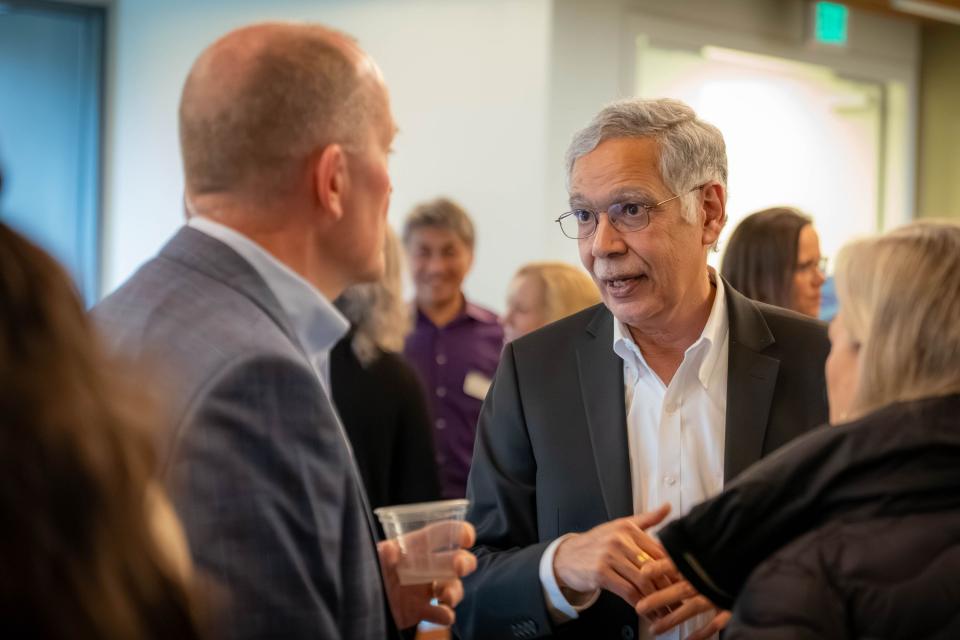
Graduate School of Management Dean H. Rao Unnava speaks with attendees during a reception at Gallagher Hall before the Dean’s Distinguished Speaker presentation.
Related content

It’s More than a Super Bowl, it’s a Super Bowl in Las Vegas
UC Davis alumnus, Allegiant CEO Maury Gallagher has a front row seat

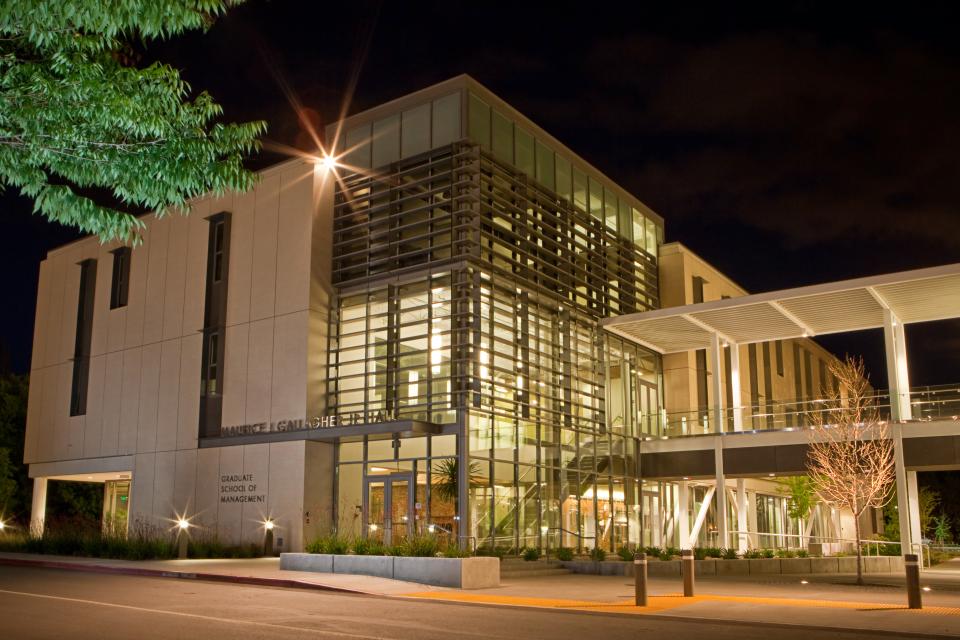
UC Davis Main Campus - Maurice J. Gallagher, Jr. Hall
Full-Time MBA, Master of Management, Master of Professional Accountancy and Executive Education